
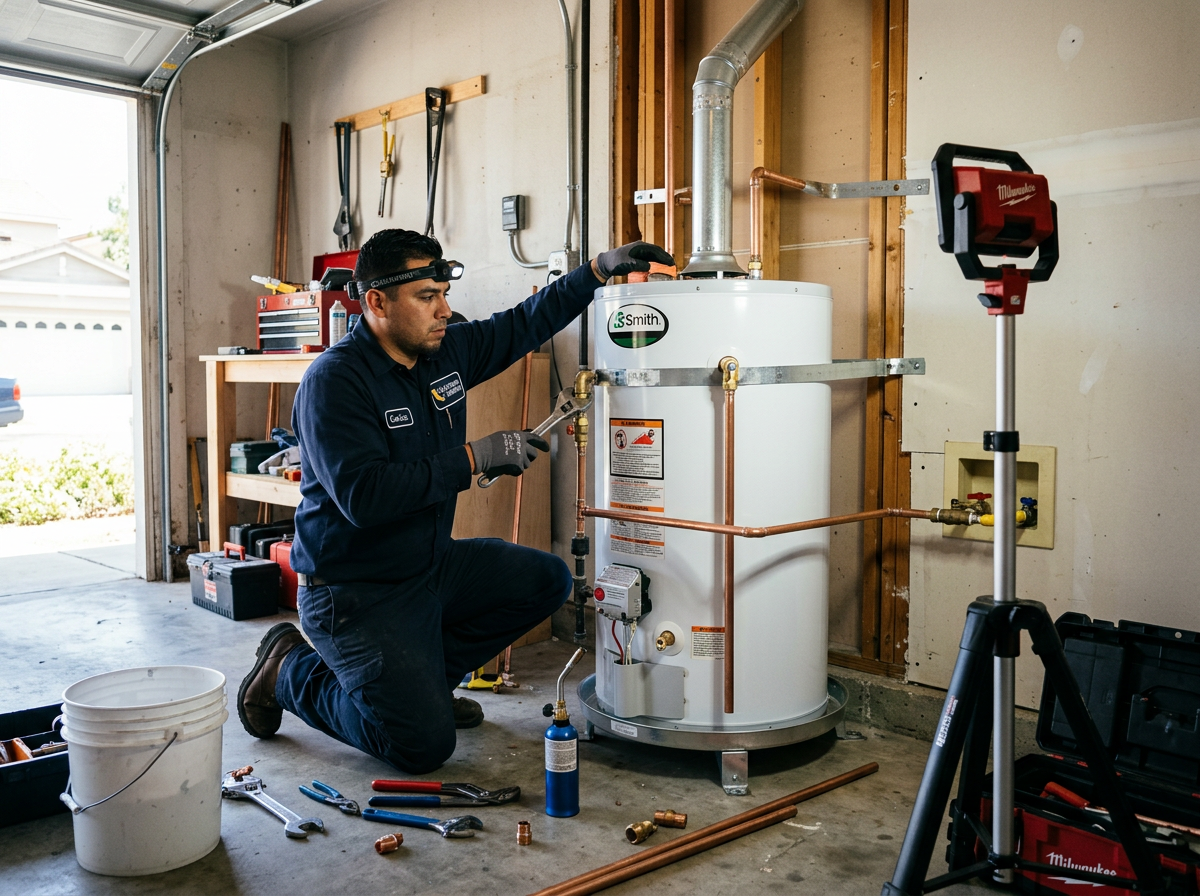
Whitewater properties along I-10 and near the San Gorgonio Pass feature a mix of older and newer desert homes that often place water heaters in garages or exterior closets. Extreme summer heat and hard water affect every service type from replacement to installation.
Technicians travel from Torrance via the I-10 corridor to handle access challenges in this small Riverside County community, adapting to seasonal heat that influences scheduling and equipment choices year-round.
Everything that follows applies right here in Whitewater (92282): the offerings, the process, and the pricing approach we use statewide.
In coastal and inland California homes, water heater installation often starts with assessing whether the existing tank has failed due to sediment buildup or anode rod depletion, which accelerates in hard-water areas away from the coast. A proper install begins by confirming the right capacity for the household's peak demand rather than simply matching the old unit's size, because undersized tanks lead to constant recovery issues while oversized ones waste energy. Seismic strapping must be placed in the upper and lower thirds of the tank, clear of controls, and the T&P valve discharge line needs to run full-size, downhill, and terminate safely outside to pass inspection.
Closed water systems created by a pressure-reducing valve or backflow preventer require a thermal expansion tank during replacement; without it, the T&P valve will weep and eventually fail. Older garage units demand the ignition source sit eighteen inches above the floor unless the model is FVIR-rated, and foothill propane systems need orifice and sizing adjustments that differ from natural gas coastal installs. Skipping these steps is the most common reason a new unit fails its first inspection or leaks within the first year.
How It Works in Whitewater
- 1
Site Assessment
Measure demand, check existing venting, gas or electric supply, seismic clearance, and water pressure to determine the correct unit and any required upgrades.
- 2
Code Preparation
Install seismic strapping, thermal expansion tank if needed, and route T&P discharge to meet California requirements before setting the new heater.
- 3
Unit Placement and Connection
Position the new water heater, connect water lines, gas or electric supply, and venting while maintaining required clearances and combustion air.
- 4
Testing and Haul-Away
Fill, pressurize, check for leaks, verify ignition and safety controls, then remove the old unit and restore the work area.
Water Heater Installation Services We Offer in Whitewater
✓Tank Sizing and Upgrade
Matches capacity to actual household demand and upgrades to higher-efficiency models when the existing unit no longer meets flow needs.
✓Seismic Strapping to Code
Installs two straps in the upper and lower thirds of the tank, positioned clear of controls, to satisfy California seismic requirements.
✓Thermal Expansion Tank Installation
Adds the required expansion tank on closed systems to prevent T&P valve weeping after a pressure-reducing valve or backflow preventer is present.
✓Old Unit Removal and Haul-Away
Disconnects and removes the existing water heater, including proper disposal so the site is clear for the new installation.
✓Permit and Inspection Support
Coordinates the necessary permits and schedules the inspection so the completed work meets local code before sign-off.
✓Gas Line Assessment for Installation
Evaluates existing gas piping and identifies any upsizing needed to support the new water heater's requirements.
Serving All of Whitewater
We regularly handle water heater installation jobs near:
- 📍San Gorgonio Pass
- 📍I-10 corridor
- 📍Whitewater Canyon
- 📍Desert washes near I-10
Water Heater Installation Pricing in Whitewater
Final cost depends on access, required gas line or venting changes, and whether a tankless conversion is involved; call for an on-site assessment.
Want the full picture of this service? See our Water Heater Installation page, or everything we do in Whitewater, CA.