
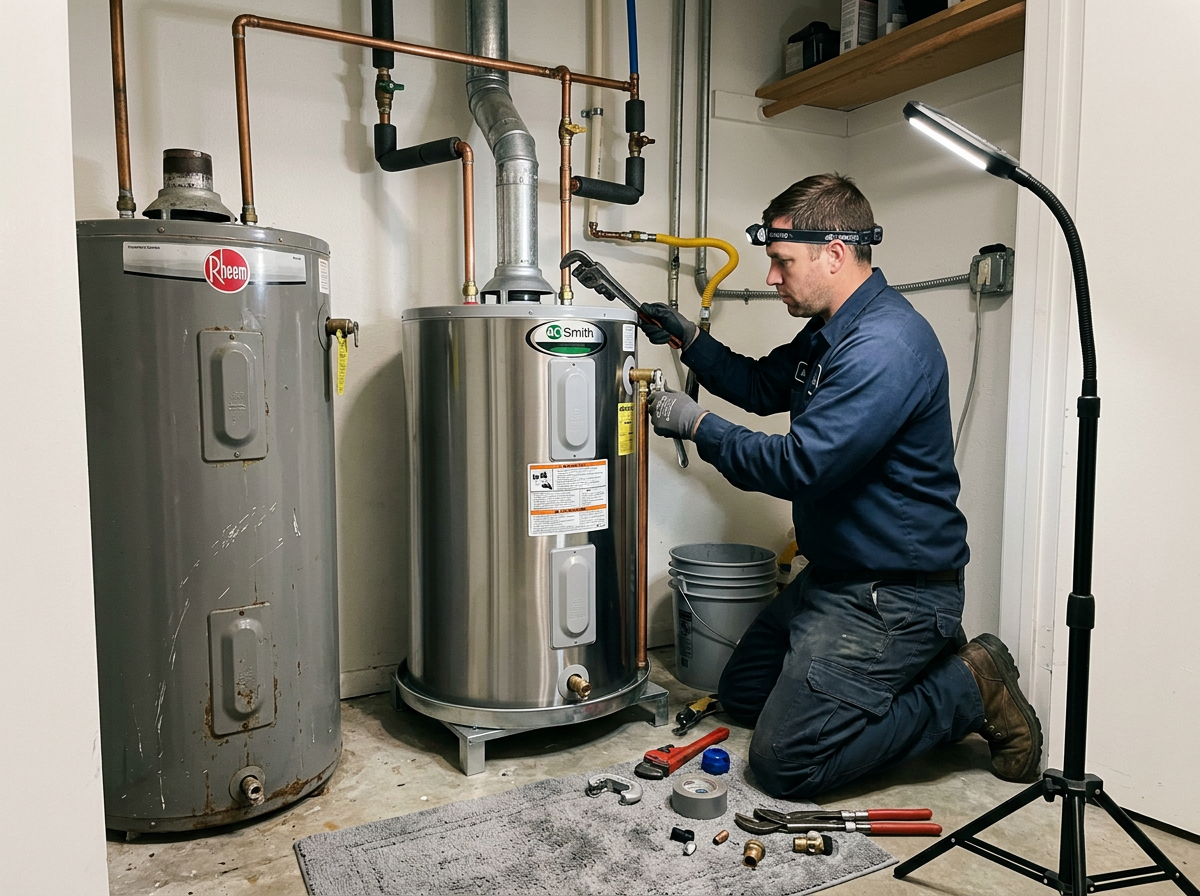
Water heater failure in California homes often shows up first as rusty water at the tap or a slow drip from the temperature and pressure relief valve. Once winter temperatures drop, older tanks with thinned walls from inland hard water can split along the seam and flood the garage or utility closet. Replacement starts with shutting off the gas or power and the main water supply, then draining the tank completely before cutting the lines.
Right-sizing matters more than matching the old gallon capacity because a larger household or added bathroom can overload a like-for-like swap and shorten the new unit’s life. Installers must add two seismic straps, one in the upper third and one in the lower third of the tank, clear of controls, and run the T&P discharge line full size with a downward slope that terminates outside. In closed systems created by a pressure reducing valve or backflow preventer, skipping the thermal expansion tank is the most common reason the relief valve weeps after the job.
Water Heater Replacement Near You — Choose Your City
Every city below has its own local Water Heater Replacement page with coverage details.
San Diego County
El Dorado County
San Joaquin County
Riverside
Sacramento County
Sacramento
Riverside County
San Diego
Monterey
Placer County
Orange
Yolo County
Calaveras
Los Angeles County
Sutter
San Bernardino
San Mateo County
Sutter County
Placer
Amador County
Ventura
El Dorado
Los Angeles
Yuba
Solano
Amador
Marin County
Monterey County
Older gas units in garages require the ignition source raised eighteen inches above the floor unless the new model carries the FVIR rating. Propane tanks in foothill homes need different orifices and sometimes larger supply lines. The final step is hauling the old tank away so it does not sit in the driveway and scheduling the inspection so the city signs off on the strapping and venting.
Cheap swaps that reuse old flexible connectors or omit the expansion tank pass the first week but fail the first hard freeze or city inspection. Proper replacement includes verifying combustion air openings remain clear and confirming the new anode rod matches local water chemistry so the tank lasts as long as the manufacturer expects.
Technician insight
In Torrance the thing that catches most people out with water heater replacement is the closed water system created by the city’s backflow preventer. Homeowners replace the tank and two weeks later the T&P valve starts dripping because no one added the expansion tank. We also see a lot of 1970s and 1980s garages where the old atmospheric vent never had proper combustion air openings, so the new unit fails inspection until we add the screened openings.
Garage Tank Split After Hard Freeze
A Torrance homeowner noticed rust in the shower and then found standing water around the tank. We found the original unit had no seismic straps and the T&P line terminated inside the garage. We replaced it with a correctly sized model, added the two required straps, installed an expansion tank, and ran the discharge line outside before the city inspector arrived.
Water Heater Replacement Services We Offer
✓Tank Sizing and Upgrade
Measure actual hot water demand and select the correct capacity and fuel type instead of replacing with the same undersized unit.
✓Seismic Strapping to Code
Install two approved straps positioned in the upper and lower thirds of the tank to satisfy California earthquake requirements.
✓Thermal Expansion Tank Installation
Add the required expansion tank on any closed system so the T&P valve stops weeping after the new heater is in service.
✓Old Unit Removal and Haul-Away
Drain, disconnect, and remove the existing water heater from the property so nothing is left behind after the job.
✓Permit and Inspection Support
Pull the required permit and schedule the city inspection so the seismic strapping and venting pass on the first visit.
How it works
- 1
Site Assessment
Measure the existing tank location, gas or electric supply, venting path, and household demand to determine the correct replacement size and any needed upgrades.
- 2
Code-Compliant Preparation
Shut off utilities, drain the old tank, and prepare the space while confirming seismic strap locations and thermal expansion requirements.
- 3
New Unit Set and Connection
Position the replacement heater, install two seismic straps, connect water, gas or electric lines, and run a full-size T&P discharge line that terminates outside.
- 4
Testing and Haul-Away
Fill, pressure-test, check for leaks, light the pilot or restore power, then remove the old unit and schedule the inspection.
Pricing
Final scope depends on access, fuel type, required venting or gas line changes, and whether an expansion tank or upgraded straps are needed. Call for an on-site quote.