
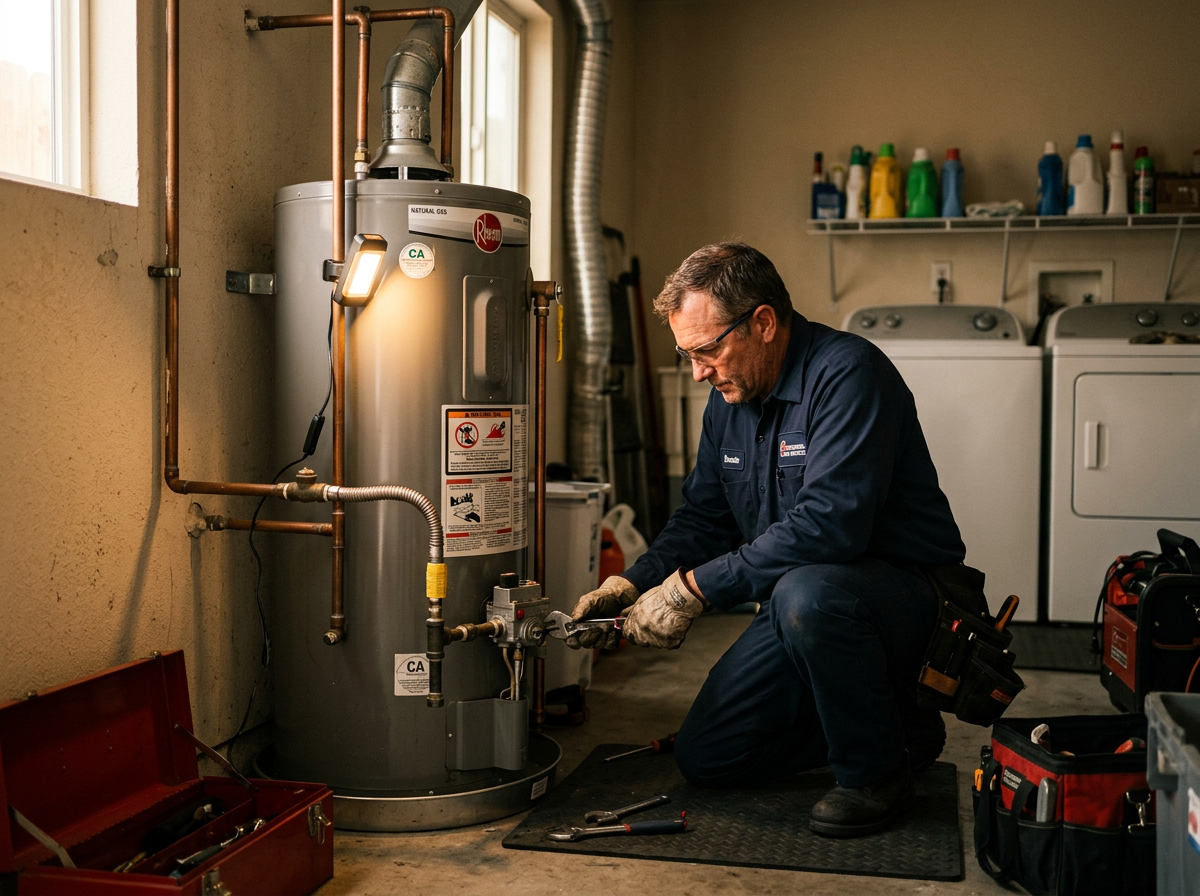
Water heater failures in California homes often show up first as inconsistent hot water or a leaking T&P valve rather than a sudden total shutdown. A technician starts by checking the thermocouple or gas control valve on gas units, then tests heating elements and thermostats on electric models while confirming the anode rod is still protecting the tank. Sediment buildup from hard water accelerates corrosion inland, so flushing is performed through the drain valve until the water runs clear, but once the tank wall has thinned or the dip tube has failed, repair stops and replacement becomes the only code-safe option.
Seismic strapping must remain intact or be upgraded during any repair visit because inspectors check the upper and lower thirds of the tank on every permitted job. When a closed system from a backflow preventer is present, an expansion tank is verified or added so the T&P valve stops weeping after the repair. Older garage units without FVIR rating require the ignition source to stay eighteen inches above the floor, and skipping this detail during a control valve swap is a common reason a job fails inspection.
Water Heater Repair Near You — Choose Your City
Every city below has its own local Water Heater Repair page with coverage details.
San Diego County
El Dorado County
San Joaquin County
Riverside
Sacramento County
Sacramento
Riverside County
San Diego
Monterey
Placer County
Orange
Yolo County
Calaveras
Los Angeles County
Sutter
San Bernardino
San Mateo County
Sutter County
Placer
Amador County
Ventura
El Dorado
Los Angeles
Yuba
Solano
Amador
Marin County
Monterey County
Propane units common in foothill homes need orifice and venting checks that natural gas units do not, while coastal Torrance homes see faster anode consumption from occasional salt air. Technicians carry both standard and high-demand elements because breaker sizing and wire gauge must match the replacement part. Honest limits are stated on site: once multiple components fail or the tank shows visible rust at the seams, continued repair wastes money and risks leaks that damage surrounding finishes.
Technician insight
In Torrance the thing that catches most people out with Water Heater Repair is the combination of older garage installations and coastal air that eats anode rods faster than inland homes expect; homeowners often replace the thermocouple only to have the T&P start weeping because no one checked for a thermal expansion tank on the closed system.
Garage Unit Pilot Failure After Sediment Buildup
A Torrance homeowner reported the pilot would not stay lit and water temperature fluctuated. Inspection showed heavy sediment at the bottom of the tank plus a weakened thermocouple. The thermocouple and anode were replaced, the tank was flushed until clear, and the existing seismic straps were tightened to code. The unit now holds temperature without further pilot issues.
Water Heater Repair Services We Offer
✓Thermocouple and Pilot Repair
Restores reliable ignition on gas water heaters by replacing the thermocouple, cleaning the pilot assembly, and verifying flame characteristics meet current venting and combustion air standards.
✓Gas Control Valve Replacement
Swaps out faulty gas valves that cause temperature swings or failure to light, confirming the new valve maintains proper pressure and integrates with existing seismic strapping.
✓Heating Element and Thermostat Replacement
Replaces upper and lower elements plus thermostats on electric units after testing for continuity and confirming breaker and wire sizing support the load without overheating.
✓Anode Rod Replacement
Extends tank life in hard-water areas by installing a new magnesium or aluminum anode, performed during a flush so sediment does not interfere with the new rod.
✓Sediment Flush
Removes mineral buildup that shortens element and tank life, using repeated drain cycles until outflow is clear, especially important for inland and desert properties.
✓T&P Valve Replacement
Installs a new temperature and pressure relief valve with full-size discharge piping routed downhill and terminated outside, correcting weeping caused by missing expansion tanks.
How it works
- 1
Safety Shutoff and Diagnosis
Water and gas or power are isolated, then the unit is inspected for active leaks, venting issues, and component failure using manufacturer-approved test procedures.
- 2
Component Testing and Access
Thermocouples, valves, elements, and thermostats are tested in place; access panels and insulation are removed only after confirming no gas odor or electrical hazard remains.
- 3
Repair or Replacement Decision
Parts are swapped only when the tank itself remains sound; seismic strapping, expansion tank presence, and discharge piping are corrected to code during the same visit.
- 4
System Verification
The unit is refilled, purged of air, and fired or energized while monitoring for proper draft, temperature recovery, and absence of leaks before restoring full service.
Pricing
Final cost depends on the exact component, tank access, and any code corrections required; call for an on-site assessment in Torrance or surrounding areas.